Scientific article / THE TONE DESK
Reading the Melasma Trial Behind a Triple-Combination Formula
Follow the diagnosis, denominators and outcome definitions before connecting an eight-week result to a prescription cream or a care provider.
A percentage becomes useful only after its question is clear. In a melasma study, it might describe people crossing a severity threshold, the average change in a score, or the proportion with no visible disease on a particular scale. Those answers can all be legitimate while telling different stories. The Tone Desk reads this triple-combination trial by keeping the question attached to every number, then separating the medicine studied from the service through which someone might obtain care.
This analysis uses the full Chinese trial report, official US prescribing information, an original sunscreen study and the FDA’s consumer notice. Its purpose is to explain the evidence rather than select a treatment. Our interpretation follows three steps: identify the comparison that was actually made, examine how improvement and harm were counted, and ask which decisions remain outside that experiment. A useful review should make that chain visible enough for a reader to inspect, including where a confident sounding conclusion would require another study.
Study facts at a glance
Study population: Single-center Chinese subset: 53 randomized; 52 analyzed; 44 completed. Source 1
Primary outcome: Two/three-grade improvement on the 0–3 Melasma Severity Scale. Source 1
Studied formulation: Topical hydroquinone 4%, tretinoin 0.05% and fluocinolone acetonide 0.01%. Source 1
US labeled role: Tri-Luma: short-term treatment of moderate-to-severe facial melasma, not maintenance. Source 2
OTC status: FDA reports no approved or legally marketed over-the-counter skin-lightening products. Source 4
Start with the people and the comparison
Participants were predominantly women with epidermal melasma, aged 33–55. All received cleanser, moisturizer and sunscreen; the eight-week trial was randomized and double-blind. These design features address different problems. Random allocation helps distribute measured and unmeasured characteristics without letting treatment preference decide the groups. Blinding helps keep expectations from steering observation. Neither feature makes a selected clinic population representative of every person searching for a dark-spot product.
The analysis excluded one untreated participant and used last observations for missing follow-up. Carrying a measurement forward preserves an earlier observation in the calculation; it does not reveal what happened afterward. As an illustrative possibility, someone could improve after leaving, worsen, or remain unchanged. The method supplies one answer where several remain possible. It is therefore worth distinguishing enrollment, analysis and completion rather than treating all three counts as interchangeable evidence of follow-up.
The shared skincare also defines the comparison: its background should stay attached to the cream result. This is an editorial inference about experimental design, not a claim that we can allocate a percentage of improvement to each background product. Start the clinical question with a description of the concern, because a treatment comparison cannot establish a stranger’s diagnosis.
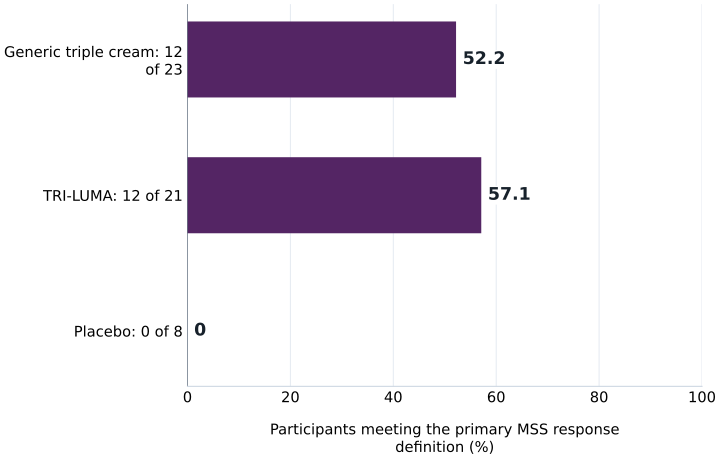
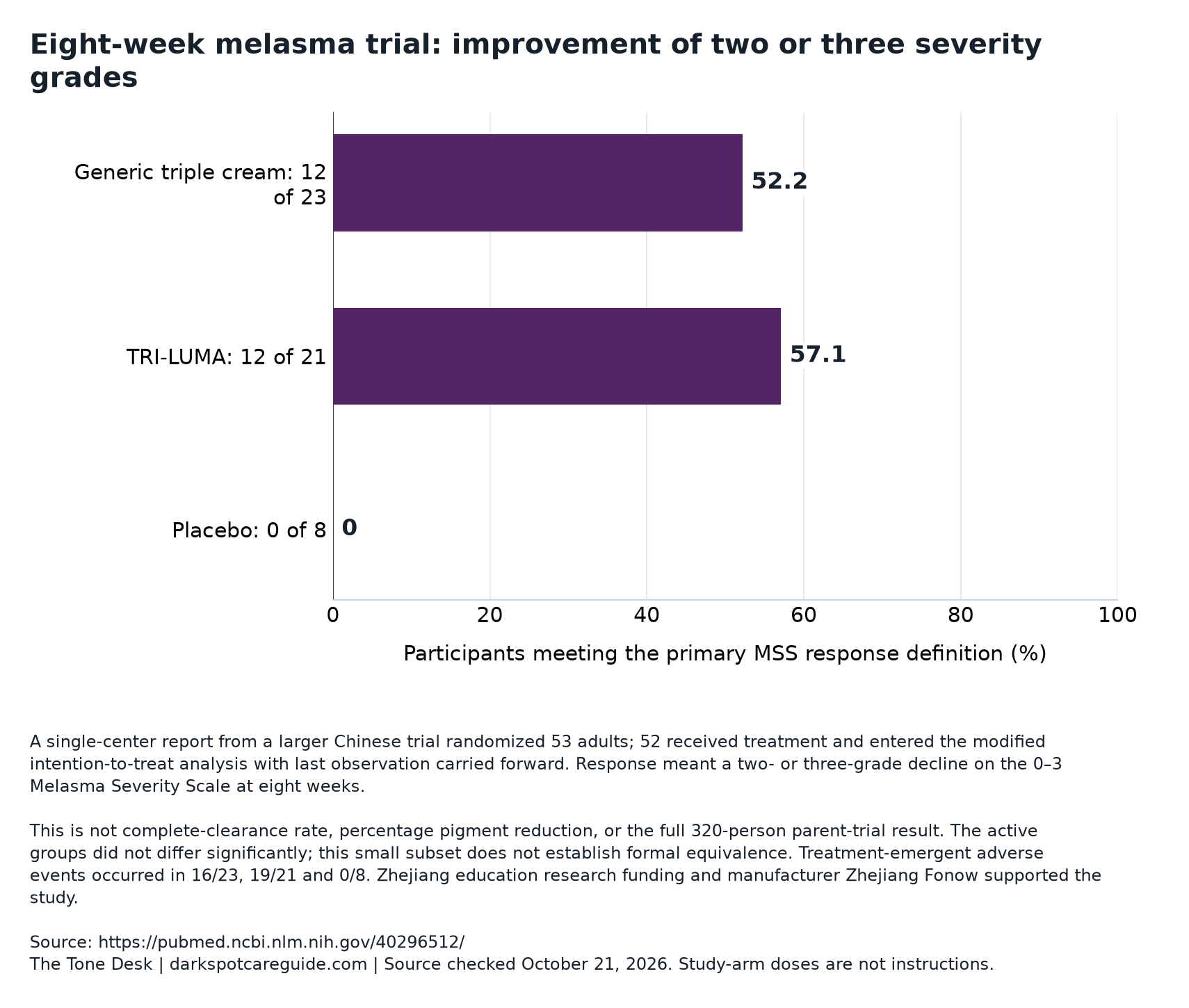
Read the underlying chart data: download CSV or download the source-labeled chart.
Read improvement as movement on a scale
Consider the primary endpoint as a rule for sorting outcomes. In an illustrative severity scale with zero meaning clear, a person starting at grade three can improve by two grades and finish at grade one. That person meets a two-grade improvement rule without reaching zero. A person beginning at grade two would have to reach zero to improve by the same amount. The same response definition can therefore combine different final appearances.
That arithmetic explains why a headline should preserve both the starting requirement and the success rule. It also shows why improvement is not the percentage of pigment removed. A category score is a structured judgment, not a physical quantity of pigment collected and weighed. Movement between categories does not necessarily represent equal biological distances, even when the categories have consecutive numbers.
The table keeps the report’s outcomes separate. The counts show who crossed a threshold, while the last column summarizes changes in a different index. Neither column records an individual promise. Our guide to the limits of care photographs addresses the same distinction from another direction: an image can document appearance without supplying the full measurement rule needed for a clinical comparison.
MASI: mean percentage reduction.
| Arm | MSS response | Mean MASI reduction |
|---|---|---|
| Generic cream | 12/23 (52.2%) | 63.2% |
| Tri-Luma | 12/21 (57.1%) | 72.9% |
| Vehicle | 0/8 (0%) | 24.7% |
A threshold, an average and uncertainty answer different questions
A separate MASI threshold—at least 50% improvement—produced responder proportions of 69.6% and 81.0% in the active groups. MASI means Melasma Area and Severity Index. Notice the difference between asking how many people cross a line and asking how much people improve on average. The first deliberately discards some information about the size of each person’s change. The second combines changes but can conceal how unevenly they are distributed.
For a purely illustrative example, two people improving by 40% and 80% have a mean improvement of 60%, but only one crosses a 50% response threshold. Two other people improving by 60% each have the same mean and twice the responder proportion. These invented numbers explain the mathematics; they are not reconstructed participant results. They show why substituting an average for a responder rate changes the claim.
Uncertainty needs its own label as well. A standard deviation describes variation among observations. A confidence interval describes uncertainty around an estimate under specified assumptions. One cannot relabel the first as the second to make a result appear precise. For evaluating a formula, the corresponding practical habit is to keep the full measurement identity attached, just as ingredient percentages need their context before they become a comparison.
A nonsignificant comparison does not establish equivalence
The active comparison was nonsignificant, not an equivalence finding. A conventional difference test asks whether the data provide sufficient evidence against a particular no-difference hypothesis. An equivalence analysis asks a different question: whether plausible differences fit inside boundaries considered acceptably small. Failing to answer the first question positively does not automatically answer the second.
Imagine an illustrative estimate whose uncertainty stretches from a meaningful advantage for one cream to a meaningful advantage for the other. Such a result may fail a difference test because it is imprecise. Describing the creams as interchangeable would conceal that uncertainty. Conversely, an estimate can be precise enough to exclude important differences even when a tiny numerical difference remains. Precision and numerical sameness are separate ideas.
For an equivalence claim, a reader should look for a justified margin chosen before the results, an appropriate analysis and an interval that satisfies that margin. A familiar brand name cannot supply missing statistical evidence. Nor can matching active ingredients settle every question about a finished product. Our formula-change guide is a useful documentary companion: identify exactly which product version a claim concerns before deciding how far the evidence travels.
The US label uses another success rule
The US label’s trials counted complete clearing: 32/85 (38%) and 10/76 (13%) for Tri-Luma in two separate studies, against dual-active combinations. These percentages should not be lined up against the Chinese study’s headline as though one experiment repeated the other. Changing the comparator changes the question; changing the success rule changes who qualifies. Even identical durations cannot repair those differences.
An editorial comparison can instead map what each instrument measures. The table below does that without ranking studies by the largest number. It includes a sunscreen investigation to show why objective measurement does not mean that every objective endpoint has the same meaning. A color instrument can detect a change in contrast without establishing that a clinician would classify the condition as cleared.
This is also why product identity and regulatory identity deserve separate fields in a review. A published study can investigate an effect, while an official label defines the conditions attached to a particular approved medicine. Reading one does not make the other unnecessary. The useful question is whether a proposed claim preserves the population, formulation, comparison, measurement and duration that make its source interpretable.
Different endpoint definitions should remain separate when studies are discussed together.
| Evidence record | Outcome definition | Interpretation question |
|---|---|---|
| Chinese cream trial | Change in MSS category | How far did severity move? |
| US Tri-Luma label trials | MSS zero: cleared | Was the final severity category zero? |
| Five-month sunscreen study | Primary colorimetry; secondary clinical mMASI | Did measured color contrast or clinical severity change? |
Read the adverse-event record by outcome
Treatment-emergent events: generic 16/23 versus Tri-Luma 19/21, nonsignificant overall. Irritation was 12/23 versus 17/21 (P<0.05); one Tri-Luma participant withdrew for exfoliation. The event-specific difference does not establish overall safety superiority. A composite count of people with any event and a count of one symptom are distinct outcomes. The same person can contribute to several symptom categories, so adding category percentages can count people repeatedly.
Safety comparisons also require attention to timing and attribution. An event occurring after treatment starts is not automatically proven to result from that treatment. Conversely, an unpleasant event can matter to someone’s experience even when causation remains uncertain. Duration, severity, persistence and reasons for leaving the trial help distinguish these questions; a single label such as tolerable cannot substitute for that information.
The US label warns about irritation, ochronosis, sulfite reactions and systemic corticosteroid effects. Those warnings broaden the clinical conversation beyond the trial’s symptom counts; they are not estimates of how often every reader would experience harm. As an editorial implication, readers need an identifiable route for a clinical question rather than assuming that a billing contact can assess a reaction. Our guide to follow-up channels explains how to inspect that distinction in a care record.
Eight weeks of observation cannot measure lasting control
No atrophy/telangiectasia was reported over eight weeks. The meaning of a zero depends on how long people were observed and what the study could detect. An observation window can be useful for common, early events while remaining poorly suited to uncommon or delayed outcomes. Absence in that window does not establish absence under longer exposure. This is a limit of the question asked, rather than a reason to erase the observations.
The label says melasma commonly recurs after treatment stops. Improvement while a product is being studied, persistence after it ends, and response to later treatment are separate timelines. To investigate lasting control, a design would need to define what counts as recurrence, when follow-up starts and what other care is permitted. Otherwise later changes could reflect several interventions, environmental exposure or missing observations rather than a single product effect.
The five-month tinted-sunscreen study offers a different experimental window, not an extension of these cream participants. Its clinical mMASI comparison did not establish a between-group difference. Our interpretation is that readers should resist joining separate trials into an imagined treatment sequence: evidence about one intervention after another requires a design that actually follows that sequence. A longer calendar alone does not make studies directly comparable.
Separate observed participants from people outside the study
A trial’s eligibility criteria are an entry gate; its actual participants are the people who passed through it. Those descriptions answer different questions. A broad permitted age range, for example, does not demonstrate that every age in that range contributed data. Similarly, recruiting from a defined setting can produce an informative comparison without resolving whether the same effect would appear in another setting with different care access or patterns of exposure.
The US label notes that skin phototypes V and VI were not studied and does not establish efficacy for other hyperpigmentation conditions. This should remain an evidence boundary, not become a prediction of failure or success for an individual. Missing evidence cannot justify either direction. It also cannot be repaired by treating all concerns described as dark spots as a single diagnosis.
The practical scientific task is to identify possible reasons a result might change, then ask whether they were tested. Differences in starting severity, measurement technique or concurrent care are candidates for investigation, not explanations proved by observing two different percentages. A sound review distinguishes a plausible modifier from a demonstrated subgroup effect. It should not invent a subgroup result merely because a biological explanation sounds convincing or because a marketing category uses familiar language.
Keep a product record distinct from a provider record
A trial compares interventions under specified conditions. A provider review asks additional documentary questions: which product is identified, what information supports its description, and how clinical and commercial responsibilities are explained. Those questions can be worth investigating without pretending the trial measured them. Our interpretation is that the evidence chain is strongest when each claim points to the type of record capable of supporting it.
For example, the CoreAge Rx Spot On review can be used to inspect its documentary terms. Linking that record here does not establish that its product matches the studied cream or inherits its outcomes. Matching one ingredient name would not establish a match for concentration, formulation, manufacturing record, diagnosis or study conditions. A provider’s service name is not itself a clinical intervention tested by random assignment.
The FDA notice also records reports of rash, facial swelling and potentially permanent ochronosis from hydroquinone skin-lightening products. Such reports identify concerns; without a suitable denominator and comparison they do not produce a personal risk percentage. The notice’s OTC statement should not be converted into a finding about an unexamined compounded product, and it does not erase the separate prescription label. Regulatory claims need their own directly relevant documentation.
Use funding information to sharpen the questions
Zhejiang education grant Y201839775 and manufacturer Fonow supported the study; Fonow supplied products. Authors declared no conflicts. These statements should appear together rather than selecting the one that sounds reassuring or alarming. Financial support is relevant context, but it is not a mathematical adjustment to the outcome. Nor does a disclosure alone show that a particular result was manipulated.
A useful response is to examine the decisions that could influence interpretation: which outcome received priority, how missing observations were handled, whether uncertainty accompanies the comparison, and whether the conclusion extends beyond the design. These questions remain appropriate for publicly funded studies as well. They make scrutiny reproducible instead of asking a reader to decide credibility from a sponsor’s identity.
The same discipline applies when navigating a commercial care record such as the Musely dark-spot review. That link invites inspection of documentary terms, not a clinical recommendation or an assertion that the service offers the studied formulation. In editorial terms, keep three records distinct: a study’s measured result, a medicine’s current regulatory information and a provider’s documented offer. Connecting them requires evidence at each step, not a shared ingredient name or a familiar percentage.
Questions about the evidence
Does a response percentage tell me how much an individual’s pigmentation changed?
No. A responder percentage counts people who met a defined rule. It does not describe the amount of change in each person counted, and people who fall short may still have changed. Read the rule first, then look for a separate measure describing the size and distribution of change. Those are complementary questions, not competing versions of the same statistic.
What would make an equivalence claim more convincing?
Look for a clinically justified boundary for acceptable differences, chosen before the findings are known, and an analysis precise enough to remain within it. A study designed to detect a difference does not automatically settle equivalence when it fails to find one. This is a methodological requirement, not a judgment about whether a particular person would notice a difference.
Can a formula with a similar ingredient list inherit the result?
Similarity is a reason to investigate the connection, not the connection itself. Ask whether the finished product, concentrations, diagnosis, background care and outcome being claimed match the evidence. Where those details are missing, a review should identify the gap rather than calculate an expected benefit. A prescribing label and a research article each support a defined product and purpose.
Why not compare adverse-event percentages across every source?
The counting rules may differ. One record might count any event after exposure, another events judged treatment-related; follow-up and ascertainment may also differ. A larger percentage cannot be interpreted as a larger causal risk without examining those definitions. Within a study, retaining the comparator and the event definition usually makes the interpretation more coherent than combining unrelated percentages.
What is the most useful question to take from this evidence?
Ask which outcome is being proposed for the specific condition and product under discussion, and what evidence supports that expectation over the relevant period. Then distinguish the clinical question from practical questions about contact, supply and fees. This structure creates a checkable conversation without turning a population result into a diagnosis, a personal probability or an instruction to use a medicine.
What this evidence supports
The most defensible reading preserves the study’s units of meaning: a defined formulation, selected participants, an eight-week comparison and separate outcome rules. Our editorial assessment is that the evidence becomes more useful when its boundaries remain visible, especially before a result is connected to a care provider. A review should let someone trace a number back to its denominator and endpoint, then identify the additional evidence needed for a longer-term, regulatory or product-specific claim. That is a stronger basis for a clinical conversation than presenting the largest percentage as a universal measure of effectiveness.
Research access and limitations
This analysis does not reconstruct participant data, unreported equivalence intervals or unpublished parent-trial results. The sunscreen short report is used for endpoint context; its supporting-information document and image-derived numerical estimates are not analyzed here. Official labeling and FDA statements were checked on October 21, 2026. No provider formulation, prescribing decision, clinical service or outcome is verified by the trial comparison.
Follow the source trail.
Published descriptions are not firsthand testing of care, fulfillment or individual outcomes.
- Efficacy and Safety of Generic Fluocinolone Acetonide, Hydroquinone, and Tretinoin Cream Compared With TRI-LUMA for the Treatment of Moderate-To-Severe Melasma in Chinese Patients: A Randomized, Single-Center, Placebo-Controlled Trial. ↗Full research article, with indexed abstract where available · Accessed 2026-10-21
- DailyMed: TRI-LUMA fluocinolone acetonide, hydroquinone, and tretinoin cream prescribing information ↗Full official prescribing information · Accessed 2026-10-21
- Comparison of Visible Light-Protective Tinted Sunscreen to Untinted Sunscreen to Protect Melasma Patients During Summer: A Prospective Randomized Investigator-Blinded Study. ↗Full primary research letter plus verified PMC funding footnote; supporting-information document and figure-derived numerical data not reviewed · Accessed 2026-10-21
- FDA warns consumers of skin products containing mercury and/or hydroquinone ↗Current FDA consumer safety notice, introductory safety text read; individual product-testing table is not used for provider comparisons. · Accessed 2026-10-21