Scientific article / THE TONE DESK
Tinted sunscreen and melasma: matching the claim to the measurement
A close reading of a sunscreen comparison shows why skin-color measurements, clinical severity and lasting control require different evidence.
A product claim about melasma needs an outcome attached to it. More uniform color, a lower clinical severity score and fewer future recurrences are different achievements. A study may help answer one question while leaving the others unresolved. Reading its measurements before judging the product gives those distinctions practical meaning: a promising finding should describe the change actually assessed, in the people actually studied.
The Tone Desk examines a tinted-sunscreen comparison through that lens. The useful question is how the research connects a defined formula to a defined observation. This article separates the study record from our methodological interpretation, then places the sunscreen findings beside prescription-treatment evidence. Those comparisons help clarify the vocabulary of a care conversation without turning a trial into a product ranking or a personal treatment plan.
Study facts at a glance
Allocation: 42 women randomized; 21 per group. Source 1
Setting: Southern France; five-month study spanning summer. Source 1
Primary outcome: Instrumental colorimetry. Source 1
Secondary outcome: Modified Melasma Area and Severity Index (mMASI). Source 1
Completion: 41 completed; one pregnancy-related withdrawal. Source 1
A comparison has a population attached to it
Participants were aged 28–58, averaging 39.5; 93% had phototype III and 7% IV. Investigators were blinded. Our interpretation begins with what that design makes possible: assignment creates a structured comparison, while masked assessment helps separate an evaluator’s expectations from the observation being recorded. Neither feature automatically makes a small sample representative of every person seeking pigment care.
Phototype describes a study characteristic; it should not become a substitute for ethnicity, a diagnosis or an individual response prediction. A reader outside the studied population needs evidence about transferability, rather than reassurance based on a broad category such as dark spots. An age average also describes the center of a distribution, not a person whom every participant resembles. That distinction matters when a headline compresses a study into a few words.
The population question comes before the shopping question. Our guide to describing a dark-spot concern offers a way to document observations without naming their cause. In a clinical discussion, identifying the condition and deciding whether research applies are separate steps. A trial cannot make the first decision merely because its photographs look familiar.
Read the underlying chart data: download CSV or download the source-labeled chart.
Product identity is part of the experimental question
The tinted product was Bioderma Photoderm M SPF50+ Golden: pVL 66, UVA-PF 35 and measured SPF 65; the untinted comparator had UVA-PF 36 and SPF 64. Here pVL refers to visible-light protection, UVA-PF to ultraviolet A protection and SPF to sun protection factor. These are reported test characteristics, not an instruction to choose by the largest number. Each protection measure has its own meaning; adding them together would not produce a valid overall effectiveness score.
The methodological value of an active comparator is that it asks what differs when both groups receive a plausible intervention. A comparison against doing nothing asks a broader question. Those designs cannot be exchanged after results arrive. Similar ultraviolet protection helps focus the question, but a finished product still includes its formulation, appearance and use characteristics. One distinguishing feature does not make every other feature irrelevant.
For a product claim, the evidence chain should therefore retain the tested identity. An ingredient category or a color description is insufficient to establish that another bottle reproduces the experiment. Our guide to changes in skincare formulas explains the documentary problem: a familiar product name can persist while the underlying record changes. The scientific question is whether the evidence still refers to the product under consideration.
Editorial questions for connecting a product claim to an experiment. These are interpretation criteria, not additional trial findings.
| Claim element | Record to inspect | Interpretive consequence |
|---|---|---|
| Product identity | Finished formula and tested version | An ingredient name alone does not establish equivalence. |
| Comparison | What the other group received | An active comparison answers a different question from no treatment. |
| Outcome | The measurement named in the result | The claim should stay within that measurement’s meaning. |
Color contrast and disease severity measure different things
Measurements preceded application. L* and ITA describe lightness and pigmentation; ΔE describes color contrast between affected and adjacent skin. The reported contrast measures improved significantly within the tinted group, but not the untinted group. The methodological question is how a relative color measurement connects to the change someone sees and to the condition a clinician evaluates.
Consider an illustrative example, not trial data: if two neighboring areas both become lighter by the same amount on a lightness scale, their difference can stay constant. If one changes more than the other, the difference can narrow. A smaller gap therefore describes a relationship between areas. It does not, by itself, say that the affected area has become normal or that the underlying disorder has disappeared.
An instrument can make a color comparison more repeatable without resolving every clinical question. The choice of measurement area, the reference area and the assessment conditions still shapes interpretation. A photograph provides another kind of record, with its own requirements for comparability. The guide to the limits of dark-spot photographs explains why a convincing visual change should prompt careful description rather than an automatic diagnosis or a clearance claim.
Two significance tests do not constitute a treatment comparison
The groups had baseline imbalances. That matters when interpreting a change relative to the starting measurement. A group beginning at a different level may have a different amount of room to change. Random assignment is valuable, but it does not guarantee identical starting values in every particular sample. A careful analysis must address the comparison it intends to make.
Here is the central statistical distinction. A within-group test asks whether observations changed over time in one group. A between-group test asks whether the groups differ on a specified comparison. Finding a change in one group and failing to establish a change in the other does not answer the second question. Those two tests can differ because their estimates have different uncertainty, even when the contrast between treatments is uncertain.
Our interpretation therefore keeps the questions separate. A stronger account of comparative benefit would identify the chosen between-group estimate, the analysis of starting values and an uncertainty interval around the result. A significance symbol alone cannot supply those details. The short report includes separate intergroup tests in its figure caption, but this article does not reconstruct numerical effects from the plot or treat its within-group statements as a substitute for them.
The clinical scores give the chart a narrower job
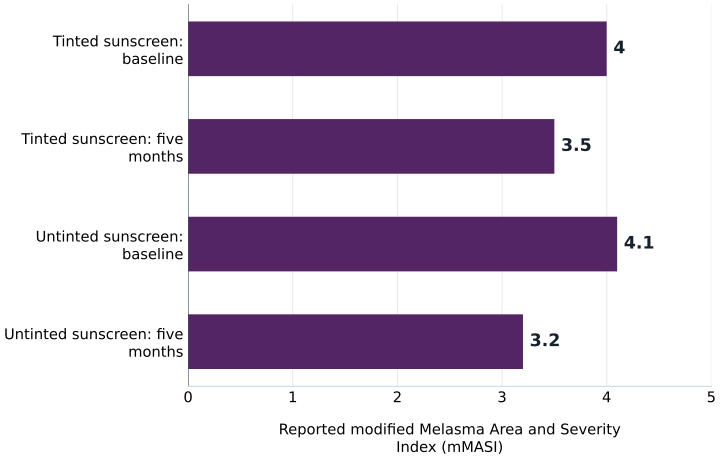
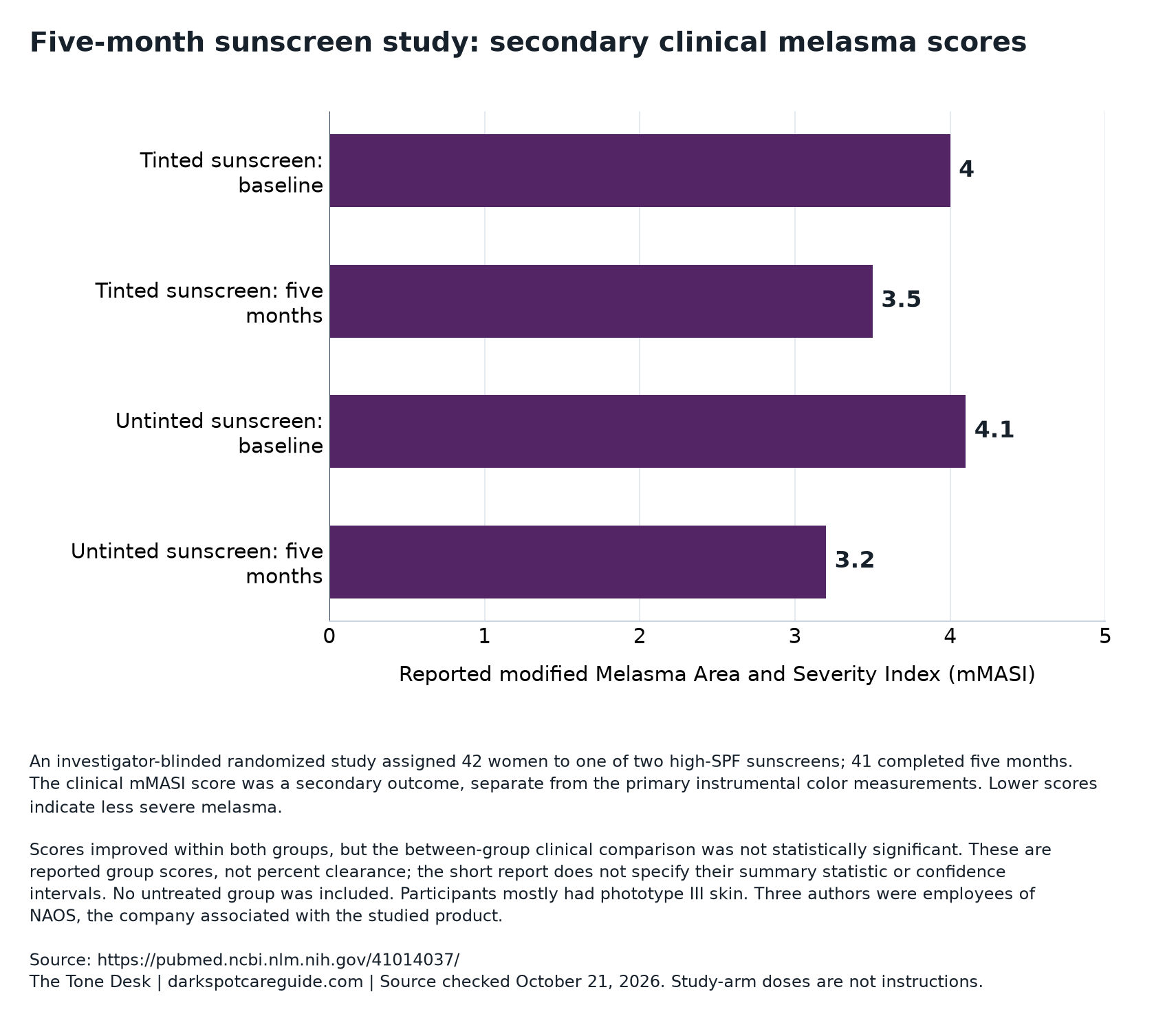
Both within-group changes had P<0.001; the between-group comparison was not significant. We label the table’s values as reported group scores. The short report does not identify their summary statistic; calling them averages would add specificity the accessible wording does not provide.
The table gives a reader enough information to see direction without inventing a responder rate. A score is a measurement on a scale; a percentage of people reaching a threshold is a count divided by a denominator. Converting one into the other requires individual outcomes and a defined threshold. It cannot be done by treating the displayed score as a percentage or by counting the apparent size of a chart bar.
Our chart interpretation is deliberately descriptive. The visible changes do not establish that either product delivered a superior clinical result. Nor does a nonsignificant comparison establish that the products are clinically interchangeable: a study can fail to distinguish treatments while remaining too imprecise to exclude meaningful differences. The practical reading is to preserve the numerical record, identify the secondary endpoint and avoid asking the graphic to make a stronger claim than the analysis supports.
Reported group mMASI scores, a secondary clinical endpoint. The displayed values are not labeled as means, clearance rates or percentages.
| Study group | Baseline score | Five-month score |
|---|---|---|
| Tinted sunscreen | 4.0 | 3.5 |
| Untinted sunscreen | 4.1 | 3.2 |
A follow-up measurement is not a lifetime recurrence estimate
There was no untreated control. That design boundary is especially relevant to the word prevention. An active comparison can describe how two approaches perform relative to each other. It cannot, on its own, quantify how much better either approach would have performed than no intervention. Our interpretation does not turn stability during observation into an estimate of the risk that would otherwise have occurred.
Recurrence also requires a clear starting state and an event definition. Methodologically, a recurrence study needs to say what counts as an initial response, when follow-up begins and what change qualifies as return of disease. Measuring pigment at scheduled visits provides useful observations, but it is not automatically the same as tracking a defined event continuously. A longer observation period introduces further questions about product use and other care.
That distinction should shape the conversation about sustained results. Someone can ask whether a claim concerns appearance during use, a clinical response at a visit or lasting control after a treatment changes. Those are answerable scientific questions when the relevant data exist. They do not require choosing between dismissing the study and treating its result as permanent. A specific, time-bounded claim can remain useful without predicting an individual’s course.
Completion and precision answer separate questions
Final arm-specific completion counts are unreported. The full short article is the basis for this reading; supplementary methods and numerical values embedded in figures were not independently extracted. Those access boundaries matter because a brief report may leave questions about analysis choices that cannot be settled by a more confident paraphrase of its conclusion.
Methodologically, retaining participants helps preserve the planned comparison, but retention is not a measure of precision. An estimate can still be uncertain when almost everyone returns for assessment. Conversely, an exact-looking decimal does not reveal how widely plausible treatment effects might range. To assess that issue, readers need the relevant uncertainty interval and the definition of the estimate, rather than the number of decimal places used to display it.
A useful next study would specify the clinical difference worth detecting, retain a clear primary outcome and report the comparison with uncertainty. It could also examine whether an instrumental change corresponds to a change participants find meaningful. These are proposals for stronger evidence, not findings of the present trial. They clarify what would make the next report more informative instead of treating every unanswered question as proof that the current observations have no value.
Tolerability and author relationships belong in the same evidence record
Both products were described as well tolerated, without comparative adverse-event counts. The study was funded by NAOS Ecobiology Company, Aix-en-Provence, France. Three authors were or had been NAOS employees; Thierry Passeron disclosed industry honoraria. These statements answer different questions: what the report says about experience during the study, and what funding and relationships readers should know when evaluating how the evidence was produced.
Our safety interpretation is limited by the form of reporting. A general tolerability statement does not provide a frequency, severity distribution or estimate of rare harms. That limitation is different from evidence that harm occurred. Readers should neither convert an unquantified statement into zero risk nor fill the gap with invented events. A useful safety report identifies how events were collected and separates an observation from a judgment that a product caused it.
Commercial relationships likewise call for scrutiny rather than an automatic verdict. The most useful questions concern control of the design, outcome selection, access to data and completeness of reporting. An employment disclosure cannot establish every funding arrangement, and an acknowledgment cannot establish who paid for the entire project. Keeping those distinctions visible allows readers to evaluate the scientific methods while understanding the documented interests around the publication.
Prescription evidence uses different definitions of success
The eight-week triple-combination analysis concerns a separate Chinese trial: its primary endpoint was a two- or three-grade severity improvement, not complete clearance. The US Tri-Luma label describes short-term treatment of moderate-to-severe facial melasma and excludes maintenance use; its pivotal trials used a cleared severity rating as their success endpoint. These are distinct research and prescribing records.
Methodologically, results cannot be ranked by placing unlike endpoint percentages in a single column. A substantial improvement threshold and a complete-clearance threshold ask different questions, even if both are expressed as percentages. The comparator, observation period and eligible population also remain part of the estimate. A sunscreen color measurement adds another type of evidence; it does not complete a missing head-to-head comparison with prescription treatment.
The label also identifies risks including irritation, hypersensitivity and ochronosis, a potentially blue-black discoloration. Those concerns belong to the medicine’s record and should not be imported as observed sunscreen events. Conversely, favorable sunscreen tolerability cannot cancel prescription warnings. Our interpretation is that complementary forms of evidence should keep their identities: the trial helps explain a finding, while the current label defines the approved product’s uses and relevant precautions for a clinician-led discussion.
A useful claim keeps the care and product records identifiable
FDA states that OTC hydroquinone skin-lightening products are not approved for safety or effectiveness and warns of reported rash, facial swelling and potentially permanent ochronosis. That notice is separate from the approved prescription Tri-Luma label. It does not establish the regulatory status of an individual compounded formula, nor does it implicate an untested provider in mercury contamination.
Our editorial interpretation is that product identity, clinical evidence and access terms should be checked as separate records. A scientific paper does not verify a seller’s current formula or service commitments. Readers examining an offer can use the Musely documentary review and the Curology documentary review to inspect the relevant records. These links do not imply that either provider supplies the sunscreen tested here or reproduces its outcomes.
The final step is to make an uncertainty concrete enough to discuss. Is the missing information the exact formula, the clinical endpoint, the relevance to a diagnosed condition or who handles a follow-up concern? Our guide to identifying clinical, pharmacy and billing channels addresses that last practical question. Clear records help a reader ask a precise question without converting an experimental observation into a promise about an unrelated service.
Questions about the evidence
Does a more uniform color measurement mean melasma has cleared?
No. A difference between neighboring areas is a relationship between measurements. Clearance requires its own definition and assessment. Our interpretation is that an appearance-related result should be described on its own terms before it is connected to a clinical claim; the two concepts need not be interchangeable.
Can I calculate my chance of improvement from the score chart?
The chart does not provide an individual response probability. That would require a specified response threshold, the number meeting it and a relevant denominator. Even then, a study proportion would describe the observed group rather than predict a particular person’s outcome with certainty.
Why does the type of comparator matter?
A comparison with another active product asks about their relative performance. A comparison with no intervention asks a different question about absolute benefit. Our methodological interpretation keeps the comparison attached to the result, so a conclusion does not silently change the question the experiment actually addressed.
Is the absence of a significant difference proof of equivalence?
No. Establishing equivalence requires a suitable design and an acceptable difference defined in advance, with uncertainty assessed against that boundary. Failing to distinguish two groups in a conventional comparison may instead reflect limited precision. The result should retain that distinction when it becomes a headline or product description.
What would make a follow-up study more useful?
Our proposed priorities are a clearly defined clinical target, an adequately informative between-group estimate and reporting that links instrumental change to patient-important experience. Longer follow-up could address a separately defined recurrence question. Those are research recommendations, not additional results or assurances about any current product.
What this evidence supports
The strongest reading preserves the chain from tested product to measurement to conclusion. Color contrast can supply useful information without serving as a clearance rate, and a clinical score can change without establishing comparative superiority. Our assessment is that this study supports a careful discussion of what was measured and how a claim should be framed. It does not support a universal product ranking. For The Tone Desk, the useful next action is to identify which part of the evidence or care record remains uncertain, then seek the specific information needed to answer that question.
Research access and limitations
This reading uses the full short sunscreen report, the separate full triple-combination article, current official Tri-Luma prescribing information and FDA’s consumer notice. It does not reconstruct figure values or claim review of the sunscreen supplement. Trial observations are not individualized prescribing advice, and documentary provider links do not transfer outcomes to those services.
Follow the source trail.
Published descriptions are not firsthand testing of care, fulfillment or individual outcomes.
- Comparison of Visible Light-Protective Tinted Sunscreen to Untinted Sunscreen to Protect Melasma Patients During Summer: A Prospective Randomized Investigator-Blinded Study. ↗Full primary research letter plus verified PMC funding footnote; supporting-information document and figure-derived numerical data not reviewed · Accessed 2026-10-21
- Efficacy and Safety of Generic Fluocinolone Acetonide, Hydroquinone, and Tretinoin Cream Compared With TRI-LUMA for the Treatment of Moderate-To-Severe Melasma in Chinese Patients: A Randomized, Single-Center, Placebo-Controlled Trial. ↗Full research article, with indexed abstract where available · Accessed 2026-10-21
- DailyMed: TRI-LUMA fluocinolone acetonide, hydroquinone, and tretinoin cream prescribing information ↗Full official prescribing information · Accessed 2026-10-21
- FDA warns consumers of skin products containing mercury and/or hydroquinone ↗Current FDA consumer safety notice, introductory safety text read; individual product-testing table is not used for provider comparisons. · Accessed 2026-10-21